
A Year of Radical Changes: Predictions for 2017
Recorded on 12/1/16
Lotte Palace Hotel
New York City
All photos © 2016 Sally Anderson
Introduction by Berit Anderson
Mark Anderson: And now to add to the Anderson Family Circus - where is she? There she is. Come on up, Berit!
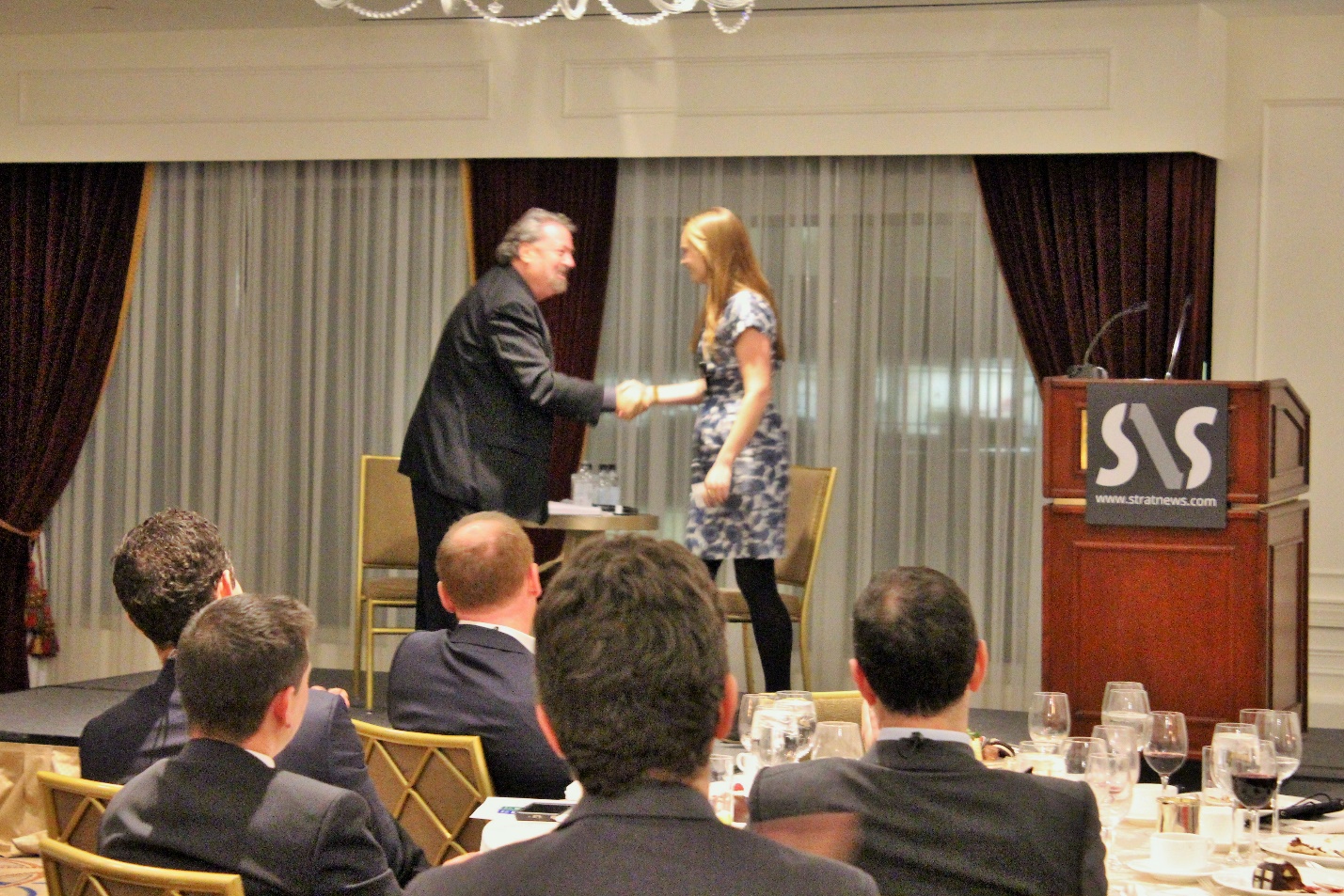
My daughter, Berit, who is an entrepreneur in her own right, CEO of Scout media. And she's going to talk for a minute or two, just very briefly, about her take on the exact same kind of work that we're doing, in her own way.
Berit Anderson: Hello. I'm here to welcome all of you tonight to the "Oh, shit" era. [Laughter] And here's what I mean by that. We're living in a world with exponential technology change. We're living in a world with shifting economic rules. And we're living in a world with new emerging international power standards. And in a time like this, it's more important than ever to have your own personal interface and way of cultivating your own personal relationship with the future.
There are a lot of people out there who will tell you that, you know, it's impossible to predict the future. They're wrong. If there's one thing that I've learned from growing up with this guy, it's that not only can you see the effects of these trends before they actually play out, but more importantly, you can see the effects of these trends far before the rest of the world has any idea that they're even on the horizon.
And so at SNS, they've been working with patterns and pattern recognition to do this. I'm the CEO of a company called Scout, and at Scout we're bringing people into that loop. What we're doing is we're building a social interface for the future. And what that means is, we are actually building a platform - a social network - that lets you connect with the predictions and the people and the news that will shape your view of the future. So we've been talking, and will continue to talk, about how we can integrate these two visions of the future, and how to think about the future and predict the future.
I'm sure you'll be hearing more about that in the months and weeks to come. But for now, I want to just turn things over to your personal "Oh, shit" consultant for the evening, Mark Anderson.
Review of SNS Initiatives
Mark Anderson: Thanks, Berit. Well done. Couldn't have been a better introduction.
We promised you this evening to talk about radical change in this coming year, and it's no secret that that's on its way. I want to start by recognizing a few of the people here, and some of the initiatives that we've created to try to deal with radical change.
Richard Hyman - are you here, Richard? Richard's helping us create INVNT/IP, which you heard [earlier] from Evan [Anderson]. So, we have Inventing Nations vs. Nation-sponsored Theft of crown jewel IP. We've spent five years on this. We're pretty serious about it; we think it's the most important thing in the global economy. So thank you, Richard, for helping us do that.
We have this [initiative] called the Carbon Trifecta. We started a company this evening, actually, so we're celebrating that process. We now have a new nonprofit, which we hope will go global, where we turn carbon capture into a real, meaningful thing instead of the bullshit it's been until now, where we turn CO2 into a very valuable commodity - the most valuable commodity in the world: graphene. And then we use 3D printing to take it from being a hobby to being a massive revolution in manufacturing, using the only chemical that could actually make that happen, which is graphene. So I'm very excited about that. We have four national laboratories that are helping us now do that.
And we have a few people here from a company called Coventry Computer - you can choose whether or not to raise your hands - but it's a stealth company, and it came out of FiRe [the SNS Future in Review conference]. We're very excited about it. It will be a radical departure in the world of computer architecture and AI.
And we have people from FiReFilms. Sharon Anderson Morris is leading it, and there are other folks here who are filmmakers. We're very happy to have you with us. We've worked pretty hard to make sure that the world knows what's going on in good things, particularly how technology drives improvements in the human condition, and FiReFilms is all about that.
And last but not least: tonight, thanks to Sally Anderson, wherever she is - we have the first [FiReBooks] physical book we've ever made: Stealth Japan, by Scott Foster, who lives in Tokyo. It's the best book on how the Japanese make money. I encourage you to buy it next week on Amazon.com.
So we're pretty busy trying to get stuff done, but tonight it's all about talk.
I usually try to break this [evening] into three pieces; I'll try to get you out of here pretty soon. I do an economic landscape conversation, and then a tech landscape conversation, then 10 quick predictions, and then we can go play some more.
The Economic Landscape
I have found it somewhat difficult to do the economic landscape because it's so simple. It wasn't simple when we started this, but now it is. And I thought of some metaphors - I hate metaphors, I don't use them, so I'm not going to use one now. But it's frustrating - I think for Evan, for me, probably for all of us at SNS - to go through the current campaign, the presidential election, and hear people attribute problems to everything you can make up: the other guy, or woman, or politics of the day, or lack of money, or stupidity, or something. It's so simple to us. Here's how simple it is: you have a nation of 1.3 billion people who have adopted a national business model which is primarily and almost solely designed to harm its trading partners.
That's what it's for. It's made for asymmetric trade. That's the point of that model. It exports more out of the country than imports in. Done. Everything else is a subset of that.
Now, ask yourself: if you ran that model in the biggest country in the world, for 20 or 30 years, what would you see now? You would see today.
So if you're listening to talk about jobs lost, or companies moved, or IP stolen, or markets destroyed, or commodities sold below price, or GDP degrading, and all these things that we're worried about today, it's pretty much a simple, one-track story. We're seeing Chapter 3 or 4 of this story. And it's particularly fascinating, I think, when you watch what's happening politically around the world.
If you actually ran those things for 20 or 30 years, you'd see those things that I just described happen. The result would be, middle classes would start to disappear in each country; they would, in fact, as one of Trump's people said the other day, be transferred to the nation which had promulgated this model; and then you'd see unrest. And the result of the unrest would be a fear of migration, of immigration, because there weren't enough jobs; the middle class had gone away.
"The only path out that's a happy story is to work with our partners and friends in China to convince them to move from this particular model to one in which they can continue to make money, but not through theft or anti-WTO behavior." |
And then you'd see the ultra-conservative people in that country, or the nationalists, become really important and start to win elections, and that's what's happening tonight, all around the world. This isn't because Marie Le Pen is pretty. She's not pretty. It's not because Donald Trump is a genius; he's pretty smart, but he's not a genius. This is because - in my opinion, this is because of one simple thing: you run this model against all trading partners for 20 or 30 years, and this is what happens. And the word "protectionism" I find offensive, because it's as though a bank shouldn't put a cop on the front curb, or inside the front door. Of course they should. That's not protectionist unless you believe that it's okay for money to be stolen from your bank. You shouldn't like that idea!
So, really, this is a simple - if you look at it from the point of view of business models - this is a simple situation. And the only path out that's a happy story, that I can see, is to work with our partners and friends in China to convince them to move from this particular type of model to one in which they can continue to make money, but not through theft or through anti-WTO behavior. They have broken every rule that the WTO ever made up. If they would agree to actually behave according to international trading rules, everyone would be happy. They would still make money - they'd make a little less, but all of us would make money. And instead of the pool being drained on this side and filled on that [50:05], you'd have everyone filling the pool a little bit. If we all were productive through innovating, through inventing things, we'd all be happy.
We're not there right now, but we could be there. And I think the more ways we find to work together to innovate, to create things, even in concert, even as partners - terrific. If we can't do that, we have to be ready to be protectionist. We have to protect our children; we have to protect our country.
It is a funny thing to me that American global corporations have no country. Chinese global corporations know where they live. They are owned by, and run by, the Standing Committee. And Putin's companies are owned by Putin. So we live in a very strange situation, where some companies have a country, in the InfoMerc world; and some companies, in what you could call the Free world, or the Inventing world, they think they're globalists, or they are globalists. You can't run the poker table all night long without drastic consequences. They will lose. So, with the full weight of the state behind you, you will always beat the competitor, because you don't have to make a profit. This is a problem.
"It's a funny thing to me that American global corporations have no country. Chinese global corporations know where they live." |
I'm not trying to be editorial about this, but this is what's actually happening. So I'm hoping that we find ways to encourage everyone to move toward a similar business model, based not on theft, based not on dumping, based not on suspension of WTO rules, but in fact based on inventing things. And if we can do that, terrific. If we can't do that, we'd better be ready - "we" meaning all inventing nations in the world - we'd better be ready to do something. Because it doesn't last forever. We will run out of poker chips. We've already routed the middle class. And it's not fair to them.
So ... end of editorial. But that is, in fact, my best picture of the economic landscape. And I'm hopeful that - I'm a very optimistic guy - but I'm hopeful that we can do this by being smart rather than ignoring ... not by being dumb, but by being smart. It never pays off to put your blinders on; you have to know what's going on.
Within all that: I will mention that the Chinese nation is lobbying right now, this night, to become declared a "market economy" at the WTO, so that we'll be prevented from using protectionist measures against their activities, which are patently illegal by WTO rules. I hope that those of you who might know people at the WTO will encourage those people to decline market status for an economy that is the least market-oriented that I've ever seen. We have some people here from Forbes and elsewhere who might write a column about this, perhaps, in the future week or so. It would be very helpful. I hope that happens too.
Another aspect of this, which is equally important, I guess, is that if you build a country on that model without the idea of future change - so, it's possible that you could start as an InfoMerc and then change, and learn that you need your customer to be healthy as well as [for] you to be healthy. Now, Japan learned that lesson, and that's why you should buy this book [holding up Stealth Japan]. It's all about learning to go from being an IP thief, and someone who's kind of using the usual model, and then saying, "No, America complained, and we're going to change. They're our most important customer, we're going to honor them, we're going to stop stealing their IP like crazy, we're going to start incrementally improving and learning how to manufacture better," and they got rich doing it. So, we actually think that Japan is doing really well, contrary to what you read in the media.
There is a way of doing this, where we exert a little pressure, and where the country involved in the earlier model changes, and both sides get rich. That does work. But right now what's happening is that China is going to crash. I know you've heard this not just from us, but from others. And it's really interesting, because in a nation that has the most intense propaganda machine and control of suppression of information, you don't get all the information very easily, and it would be heard to know that China's in a crash right now. And not just right now, but as far as we can tell, it's been about a year, or a year and a half.
So, here's this country that's crashing, crashing, crashing - but from the outside, you don't necessarily see it. What do you see? You see elites taking their money out of the country and buying real estate all along the [US] West Coast and in New York and Chicago. That's an interesting thing. That could be just because they were wealthy. But then you see the government itself flooding its own currency out of the country to buy companies around the world. That's more interesting.
Now, Japan did the same thing, but not on this scale, and not proportionate to this scale. So it's really as though the yuan is being used as an escape vehicle by the Chinese government, converted back into dollars, and then purchased whatever it is - hotels or Hollywood studios or - make a list. So, clearly the people who run China are terrified. They see, I think, the result of perhaps too long a time spent on sugar instead of meat. At some point you run out of steam. And they've run out of steam now.
If you follow economics, you'll know that at a time when they should've backed off on roads to nowhere, they're building more. At a time when they should've backed off on property bubbles, they're exacerbating the bubbles. At a time when they should've been reining in on debt, they're extending their debt. So all of these are pretty objective measurements of what I'm describing to you. And that is also part of the economic landscape we live in, because if people who leave China can't find a more reformist way of tackling their problems there will be a serious, obvious-from-the-outside collapse. Much worse than the internal collapse they're facing right now. My guess would be that will happen in the next five years, if not sooner.
It's a pretty near-term question. Can they come to grips with the reality of their own situation? Can they deal with the loss of face, if that's required, that this didn't work out, and can they come up with something new which allows their own people to prosper in a new way, even if at a lower level? I hope that they do.
"It never occurred to us that we would have to look at hotels or Hollywood as a national security question. But now we realize, if people in America can't go to the movies and see and hear free speech, we're in trouble." |
While this is happening, we also have an economic situation where the world is saying no to China. You saw the headlines a couple days ago where China was saying "We're going to back off on our" - the headline said, "We're going to back off on our M&A programs." What the story said was, "We're going to review programs of different sizes." Didn't really mean they're going to back off. I think part of this is propaganda.
But certainly Germany has started saying no to China, in terms of buying out their key companies. And the United States has started saying no to China. So we have caught on slowly but quickly - it took us about a year and a half, two years, to where we're now saying no even to hotel purchases, based on CFIUS's rejection, so we understand that there are security issues in Hollywood, there are security issues in hotel ownership because of people who stay there by the naval base; there are all kinds of security issues in things which we didn't used to think about.
It never occurred to us that we would have to look at hotels or Hollywood as a national security question. But now we realize, if people in America can't go to the movies and see [and hear] free speech, we're in trouble.
Clearly there are many more things ... when you get to large scale, there are many more things which you would miss if we didn't have them. And that's happening now, and because of that, the world is learning to say No. It reminds me of "the Japan that can say no," by Akio Morita, so many years ago. And I said already: it's not "protectionism" when you're fighting a thief.
I'm worried about TPP. I know that Mr. Trump has said that he wants to get out of it. I've been encouraged by the fact that he has backpedaled on almost every single campaign statement that he made, and so I happen to think that he's a very smart guy, and I have some hope here that, in fact, he'll end up being much more moderate than the people who are against him believe, and that he'll continue to bring in people who, whether you like their politics or not, are experienced, and by being experienced can do something pretty smart.
"It's not 'protectionism' when you're fighting a thief." |
I'm not in any way trying to apologize or be excited about him; I just want to say something that I think people haven't quite gotten, which is: he isn't the person you thought he was during the campaign. If I had to describe who I think he really is - I said this to Bill [Ribaudo] earlier - two things: he is much, much smarter than people think he is; you don't win the GOP primary as a Democrat, basically, and then win the national election versus the Clinton Foundation, or the Clinton family, as a nobody, as a real-estate developer from downtown New York. You don't do that if you aren't really, really, really smart. He is really smart. And by the way, that's a good thing, because we tried George W., so we know what happens when you put someone who's really, really not smart in the most powerful chair in the universe. So having a smart guy is good.
And the other thing he is, is he's a deal guy. He told us who he is. His very first book is called The Art of the Deal. That's all there is there. There is nothing else, in my opinion. So, you've got a guy who's spent his entire life making deals. He believes in the art of the deal. And instead of saying that he's a this or a that, or a that or a this, he'll take every morning with a new cup of coffee, and it's going to be a new day, and he'll make a new deal or two, and that's it. And it's going to be very interesting to see, from day to day, it will go up and down and up and down and left and right and up and down - to him, it'll all be the same thing. Makin' deals. And to him, that's natural. For us, it's very not natural. But I think it might be relatively okay.
It's just a whole different way of understanding how to run things than we've ever been used to before. He's definitely not a politician. So I am saying that, not because we should be thinking, "Yippee! He's there" - it's a real risk having him there. But, for all those people who are just kind of in a living mourning funk for him having been elected, I think you're wrong. I think we've got a really interesting guy in there who might do some change. And he might create some good things that we didn't expect. So let's give him a little space to try things out. And if he fails, let's crucify him. [Laughter] But if he doesn't, let's applaud.
Oil. You all saw the headlines: Oil is going to be great now, Buy oil, Get ... No, that's all wrong. No change. Despite the OPEC deal, nothing's gonna happen. My opinion is oil will remain in the same band it's been in since we made the call, which is essentially $45 to $50. Sorry, Saudis, it ain't gonna happen.
The world wakes up to the real source of immigration. So, all this talk about immigration is kind of interesting. Immigration is creating havoc around the world. We've had poor people in the world since time began. What just suddenly happened 4.9 years ago? It's a really interesting question. Some people say, "Well, it's climate change." Well, there's a little of that, in Africa and elsewhere. "Maybe it's, you know, Aleppo." No, it's not Aleppo. They looked at the people who are coming to Europe ... You know, a fraction of them are from Aleppo. So, what is it?
Well, it's money. Money. What we're going through is a fascinating time when people have the Internet, they have television, they have, you know, things like smartphones. They know that in Germany you make more money than you make in Aleppo. Or in any other part of the world. So whether you live in Afghanistan, or anywhere - I might want to go to Germany. If I have three kids and I've got no job, where am I going to go? I'm going to Germany. Or America, or Sweden. So this gigantic migration is partly caused by war. Much more important: it's caused by money.
I think this is something which we haven't addressed properly. And we needed the world to look at the question of, Are people moving purely because they want to? And maybe they even have an economic right to, I don't know. But it's not because of bad bombing raids by Russia; it's really because of ... money. And we have to ask ourselves, if we live in a country that has a high GDP, how do we feel about that?
Germany's already asking that question; we have to all ask that question. Do we want to allow hundreds of millions of people who are living in some crazy place that they don't like very much to come live in, you know, New York? That's the question. We can say no or yes, but we at least ought to ask the right question. Not "Are we going to allow these poor, bombed-out people from one town?" That's irrelevant. The question is: People all over the world are poor. Do we want to allow them to move from some place which has become desert-ified, or whatever happened there, to suburban Chicago? Yes or no? And we'd better ask that question pretty quick.
Last but not least ... This is an interesting thing. My friend Larry Smarr, who's just been through surgery (he's very healthy tonight) - Larry is a brilliant guy; he runs Calit2 at UCSD. He's probably the most famous guy in supercomputing. Larry and I do a road trip every year, and we came up with this idea - I came up with this idea, I put his name on it - it's "the Larry Number." So here's what the Larry number is. And by the way, climate change is real.
I remember sitting here - Sharon probably remembers - probably six years ago, and some nice fellow who'd never read SNS, [who] was a guest of somebody, we had a little argument over "Is climate change real?" And I said, "Well" - we talked about ice melting - and I said, "Here's the deal, you know: you're welcome to your opinion, and I'll take mine, and we'll just wait and see." The difference is they're paying 300 bucks to hear me, so probably I'm going to get it. So it turns out, yeah, it was real.
"... All countries want to live on the water. And so we have put all of our major ports; all of our major, most expensive ... If that gets turned into zero, over a short period of time, that is an interesting number. Who will pay for it? I guarantee you that the insurers and re-insurers will go broke the first day. Meaning, within 50 years. So then what happens? Who pays for it? No one." |
The Larry Number is the value of real estate that will be subsumed by storms, king tides, and water rising. Imagine the number. What is the number, if you just went in - make up some number of feet you want to talk about - you just went in a little ways on the coast, all around the world. What is the number of dollars, in destruction of real estate value - just a little, just a little bit, maybe 50 feet, 100 feet, right? I'm not sure. That's the Larry Number, whatever that is.
I'm not sure that the entire wealth of the world would pay for that. I just don't know. I haven't done the math. I don't even know how to do the math. But that is all the valuable real estate we've got, essentially. It turns out all countries want to live on the water. And so we have put all of our major ports; all of our major, most expensive ... If that gets turned into zero, over a short period of time, over a hundred years or 50 years, that Larry Number is an interesting number.
Who will pay for it? Insurance companies won't, I guarantee it. I guarantee you that the insurers and re-insurers will go broke the first day. Meaning, within 50 years. So then what happens? Who pays for it? No one's going to pay for it. The owners will pay for it. Somehow. So it's an interesting question. What happens when we hit the Larry Number?
In summary, I think, as I said last year, right now, for all these reasons and more, the US is up, and the US is going to be up again this year. Money from around the world from sovereign funds, from smart investors, from the Chinese people who are the elites, from ... make a list. They look around the world, and they're making two decisions. One is, Can I make a little money? Not much. The other is, Can I run from disaster? Yes, you can. Is there a safe place to put my money? And the answer is, Yes, it's called New York City. It's called America.
So we're seeing a huge influx of money here, not because we're that brilliant, but because we have a stable, productive business model in this country which has gone on for a long time and will go on for a long time from now, and no matter what the GDP is, that's a pretty darn good bet compared to everything else around, particularly seeing the damage done over these 20 or 30 years by this business model I was talking about.
So the US is going to be up, and that's good, if you live here.
If we look at countries ... Country by country - I'll run through this very quickly - I think we're going to see a quarter-point up from the Fed, everybody knows it, I'm going to say it's going to happen, it'll happen before the turn of the year.
China's going to be continuing to have a negative growth rate in GDP. Everyone calls it whatever they call it. I think they're lying. I could be more gentle about it, but why bother? We think it's about a negative 2. So, you know, quarter to quarter it's dropping, it's dropping, it's dropping, it's dropping. That what its growth rate is all about.
In the UK, I believe that Theresa May is as good as David Cameron and George Osborne were really, really bad. And those who were here two years ago heard me saying this about Cameron: he's now gone, rest in peace. What a disasterfor Britain. But Theresa May's pretty interesting. I think she'll be great.
Germany? I don't know what's going to happen. Merkel will probably be re-elected, but she is so tied in with the idea of immigration, and she's reversed herself already, but she may lose the election just because of that. The obvious story here is that Germany takes over the EU - and I've talked about this for a long time - there are problems in Germany economically, of course, but I keep thinking of the EU as the GU. What's equally clear is that the EU split is becoming more and more obvious. There are the northern tier states in the EU which are creating all the wealth, and then there's everybody else. And how - how the EU works this out, I don't know. But we all want - I think we all want the EU to be a successful experiment, and increasingly it's not a successful experiment.
If we look at the Middle East, what a mess. [Whistles] Wow, you know? The Saudis, I think, are going down. Assad is going to stay. Russia is now more firmly entrenched than ever in Syria. ISIS will go down, but leaves a new vacuum in Iraq, and Yemen becomes the next Iraq. Great.
Turkey. A hundred years of progress is lost to Erdogan's drive to make it into an Islamic state, what a sad story. That is so sad. Everyone was so hopeful that Ataturk did the right thing, and we'd have a secular state ... Nope! Not gonna happen.
" If you watch these elections.... For a pattern person like me, it's not a good story. You're watching country by country elect a pro-Russian leader - not just us - and you're asking yourself, Is this a mistake? Is this random numbers? Or is this part of a concerted pattern of influencing that is leading to country by country by country who you would think would've elected anti-Russians, electing Russians?" |
Russia. Continued aggression, and I think Trump has an opportunity to be tough. I don't know whether he will do it or not; maybe we'll just make a deal and bend over. But if he is tough, good. Otherwise, what we're seeing now is a really sophisticated propaganda machine working not only on our election, but on elections around the world.
And if you watch these elections, they're pretty interesting. For a pattern person like me, it's not a good story. You're watching country by country elect a pro-Russian leader - not just us - and you're asking yourself, Is this a mistake? Is this random numbers? Or is this part of a concerted pattern of influencing that is leading to country by country by country who you would think would've elected anti-Russians, electing Russians? Like Estonia, for instance. Lithuania. You would never in your worst nightmares think that they would have pro-Putin leaders, and they now do.
The countries at risk are pretty obvious: the Baltics, all three of them; Moldova, Georgia, and Ukraine. I don't think it would surprise me if Putin decided, and was probably right, that he had no risk at all in physically invading every one of those countries. I don't think we would do a thing. And I think that's how he works: I think he makes a risk calculation. He's trying to re-create the Soviet Union. He's honored by doing that, by his own people; he has very high numbers still. And as long as we don't get in the way, or NATO doesn't get in the way, I can't understand why he wouldn't do it. He'll go down as being the best leader in Russian history. They will love him forever. They'll put Lenin-like statues all over Red Square, for Putin, just like his Vladimir statue that he put up recently. So the question isn't, "Should he do that?" As a leader, he probably should. The question is, "What should we do, or what should NATO do, to discourage him from doing that?"
South Korea, I think, is in decline - I always call it Samsung Korea. Obviously we now have the head about to step down, I think, and Samsung may be split in two. The whole thing's a big mess.
Japan is rising. I would encourage you not to look at Japan solely by their own GDP numbers, but by their export numbers, which is what this great book is all about [holding up Stealth Japan]. You should really think about getting a copy of this book! And you'll find that they have so much money offshore that you can't really assess them until you look at their offshore productivity and employees and demographics.
Italy, Portugal, Spain, Greece, are essentially bankrupt. You might ask the question, "How does a country go bust?" And then say, "How many nations are bankrupt today? What does it mean? Is it possible?" Now, we think about banks failing, so that's one way to do a measurement. But really, you know, is it possible that we have many countries that are already bankrupt, and we just have no metric for it? Is it possible the US is bankrupt? We certainly lament our amount of debt. Have we accumulated too much debt? Would an objective Martian say: "Sorry, you blew the deal - you can't ever pay it back. Three generations of you will never pay it back, so you're bankrupt." I don't know; but I think it's a fair question.
All of these things have been the result of currency wars first, where China was manipulating it; Japan manipulated the currencies, South Korea did, and then China did, and everyone started playing that game of fighting with currency valuations. It was a disastrous way to go. And then quantitative easing? That's ridiculous; it's the same thing. The whole idea of printing fake money, fiat money, just to try to beat the other guy? Bad idea. And then finally, deficit spending? That could be a worse idea.
So we've been doing this thing as a community of nations for now a number of years. I'm very proud of our country that we pulled out. We pulled out of quantitative easing, we have a high dollar value to pay for it - good. Couldn't be better. Keep that dollar strong. It's tough on traders, but guess what? It means we're actually in business. That's why it's really strong - not because we pulled out, but because all the world's money came to us to buy dollars, to buy our goods and our dollars, because we're actually running a real economy instead of a fake currency war or a fake manipulative operation.
Well, that's it for that part of tonight's sunny story.
The Tech Landscape
And then the tech landscape.
I want to talk to you about something that Bill [Ribaudo earlier] mentioned briefly, and that is - and if you read SNS, you got it today - Flow. We've been working on flows for a long time; we think that flows are the best and simplest ways to understand economies of nations and companies. You don't read their balance sheets; they're often not true. You don't read their income statements; same problem. But if you read the flows of money in and out, cash flows - that's one reason that that's part of the GAAP statement now - and that's true on every level.
So if you're a hedge-fund guy and you want to understand how China's doing, you measure the flow of energy being used, and you find out that it dropped, and how much did it drop, and you can say "Now I understand the real story of what's going on in this country."
So, flows are fantastic. And we've gotten more and more involved looking at designing chips, and designing computer systems, and things like that. We do it at FiRe, we do it year-round ... And so I want to just give you a brief description of what happened at FiRe this year - Future in Review. We had the CTO Design Challenge, and we gave them the usual impossible task, which was: Design a flow computing system. Give us the complete architecture, how it works, what's the security about, why would you have it, and so on.
It turns out - and this is another Larry Smarr and Mark Anderson road trip story - that if you look forward, say, 10 years, and you ask yourself: "What would computers have to do by then?" there are no computers today that could do it. Ask yourself - and I'll mention a very funny story, but ask yourself: "What's the challenge?" Well, the challenge is, Internet of Things was up to 1 trillion objects, flows of data coming in real time off of all the objects, zettabytes, or ettabytes, or zincabytes, or some number we haven't even made up yet, of data flowing back to individual systems, trying to keep track, in real time - not storing it on a computer disk, because there aren't going to be enough computer disks in the world to do this - so, in real time, data triage, just like you're in an emergency medical situation.
Triage on the data: How much can you throw away, how much can you keep, what are the patterns in this stuff that you're keeping, what are you looking for, how do you find stuff you didn't know to look for, and then what do you do about it? And then you throw it away. Everything has to be thrown away almost immediately.
Wow! I don't think that my Dell is going to do that for me. Not even my Dell server. So, it's a really interesting challenge.
And [the members of the Design Challenge] did a great job. They designed a system which will do this, called flow computing system. I mention it because I believe it's all true. And instead of thinking about the Internet of Things - how tired are you of that one? IoT - alright, it's true: the Internet of Things is interesting. But there is no such thing as a tree falling [in the forest] if you don't hear it. It matters only if you have a flow of data from that tree to you. So, it's not an Internet of Things; it's an Internet of Flows. It's an IoF, not an IoT.
And this is a big problem. What will we do about the Internet of Flows? Whose system will capture those flows? Whose algorithms will look at those flows? Whose people will make use of those flows, and how will they do that?
This is something that nobody has really thought about. And it is the most important description of our computing task 10 years from now. So, it's a big problem.
"It's not an Internet of Things; it's an Internet of Flows.... What will we do about the Internet of Flows? Whose system will capture those flows? Whose algorithms will look at those flows? Whose people will make use of those flows, and how will they do that? This is something that nobody has really thought about. And it is the most important description of our computing task 10 years from now." |
Jumping forward: We have a fight at the bottom and a fight at the top. We've already watched my description of what the Chinese business model has done to the bottom. If you happen to be Dell Computer, you went private because of this; if you're in the PC business, good luck - it's really tough; the operating margins are going to be very tiny.
We talked last year about a push toward sub-$300 machines; that's happened now. So the floor drops out. You've got companies that don't need to make a profit in all of the major markets, dropping things down to no profit or 1%, or minus 1%, or whatever it is. And if you are a Wall Street company, you can't live there. So, it's a big problem.
At the top, it's coming. So we've got to be prepared for - I mean, certainly there'll be new innovations where that's not happening. But increasingly, it'll be happening at every level you can think of: routers; it'll be happening in servers; it's going to be happening in data centers ... so, whatever you think the top might be - chips - there's going to be a fight there, at zero margins, or 1%, or 2%, where a state will come in and subsidize those products and sell against you if you make chips or supercomputers, and you're going to be having to fight for your life.
The global chip industry is consolidating, and that's going to happen faster and faster. It's happening for two reasons. One is, there are very large vertical opportunities. So, everything's happening in silos. And if you can have complete control over that vertical, you have a better chance to fend off what I just described. So that's a very strong pressure to do this.
The other is the growing onslaught of more and more chips coming from Asia. And so they're going to come in cheaper and cheaper, and you're going to be selling your chips for less and less.
Net Neutrality is at risk, which is unfortunate but true. Just at a time when it seemed that idea had won key US battles.
Cloud computing is going to become balkanized. So just when we thought, like, the Internet is for everybody, and clouds are wonderful, and they're international ... All that shuts down, and we have a German cloud, we have the Chinese cloud, we have the American cloud ... So companies which thought - whether they're Amazon or Microsoft - which thought that they were going to have this wonderful flat surface with big multipliers and amortization costs, now it's going to turn out that they've got to re-create this stuff country by country, on a balkanized basis.
An interesting thing, I think, which is technical, is the capacity usage in GPUs is going to become a critical, if quiet, roadblock. So, kind of an unknown problem, but as yourself when you run an Nvidia chip, how much is actually being used for running that program? In most cases, not very much.
All investment is going to the cloud right now, because of current revenue increases. So think about - you see AWS or you see Microsoft Azure, you see all the big numbers - huge investments, gigantic investments. I heard the head of AWS say yesterday that they build more data-center capacity in one day than would serve all of Amazon a few years ago.
So they're constantly adding more and more, but also what's happening is these data centers are becoming like each other, in their features. And so ask yourself, if you invest all your money in something which is losing differentiation, what's the ending of that story? It's a scary story, right? Somebody will win, I guess, maybe - maybe not! Maybe it won't be you. Could be a cloud crash. It wouldn't be this year, but I think we're on the track to do that.
Publicly Rated Score
Now, every year I talk about my publicly rated score. And it moves around a little bit. And almost every year we have one or more categories where the past year's predictions aren't in yet, because they're about 2016, and 2016 is not over and we don't have all the numbers yet. That's happened again, where ... There's one call that I made about mobile retail purchases, and I don't know what they are until probably Q1 of next year.
I made a very bold, and probably stupid, suggestion, which was I thought that they'd go up 30% to 40%. That's a very big number, and I'll probably lose that bet. But I just don't know yet; so at the moment I'm riding high, at 98% [for 2016]. I'm going to guess that will drop down to 92 or something, depending upon the outcome of that one question.
So I don't really know the answer, but at the moment it looks like 95 is the [cumulative] number [since 1995], so maybe it'll drop below 94, or something else. But it won't be 92, so that's a good thing.
Top Ten Predictions for 2017
Here are the Top 10 Predictions for 2017, and then we'll have a quick Q&A and comments thing, and you can all go play wherever you want.
I always read these out. I apologize for reading, but I read these because I have to live and die by them, and so I don't wing it; I actually read them fairly carefully.
Number 1: Apple is done. Done. No more excitement, no more real innovation. Apple's failure to innovate and create new product lines has reached a critical failure point. Connected-car cancellations, the outflow of key players, the loss of Nest and its founder - [there is] nothing evident except tediously similar products and continued kowtowing to China, at a time when China rejects the company. The result for Apple is that hope really is a strategy. Do you want to buy a Cadillac?
Number 2: Hewlett-Packard. I think that HP and HPE expectations flip. And there's a lot of risk in this prediction. Contrary to current stock moves, I think that HP Inc. is up and HPE is down.
Now, HPE has two things going for it which could blow this prediction. One is that they're in servers, which is a very hot market; and the other is that they've got this monster machine coming up which could be totally cool. So we'll see.
Number 3: Qualcomm and Nvidia drive the chip world. The first has more promising company markets, and the second, more promising technology.
Number 4: Servers continue to outpace PCs in real innovation, with the next generation likely to be powered by Xeon Phi.
Number 5: CarryAlong computers outpace PCs as consumers continue to outpace producers. This category now dominates the personal compute space, represented by phablets, pads, the Surface Pro, Intel 2-in-1s, small Mac Air-like laptops.
All are in virtually the same sector.
Number 6: The New Microsoft gets its mojo back. The Windows guys become the guys inventing the Xbox, the guys inventing the HoloLens, the guys inventing the Surface Hubs, the Surface Pros, the Surface Studio - these are the guys who beat Apple for coolness in the recent New York City vs. Valley Demo Showdown.
Which stock would you rather own?
Number 7: The car replaces the PC and smartphone as the exciting new test and launch platform for apps and innovations. New efforts will include advanced connected personalization, wireless keying and synching of home/car connections, car/car connections, car/Net connections, personally informed navigation, shared memory and database, and radically new entertainment features.
Number 8: The smartphone is a zombie. Steve is dead, copycats cut margins, China and South Korea subsidize their phones, real innovation takes a vacation. Google is the only source of smartphone innovation now. For everyone else, phones show the same level of real innovation as Asian copycat patents.
Number 9: "The Shadow Knows: The Facebook Shadow Grows." Fake news, the Trump election, aiding China's censorship, Facebook CEO Zuckerman trying to name his baby after Xi Jinping - and other craven behaviors related to sucking up to bad guys and invading privacy - leave a bad taste in the mouths of anyone paying attention to Facebook's ethics. What part of your life do you really want to share with Zuck?
New social networks benefit and grow.
Number 10: Non-von Neumann gets a foothold. Real progress is made in these new architectures as the limits of the old become painfully obvious. Non-von Neumann may be not quite ready for commercialization at scale, but will be definitely breaking into the future tech road map of industry leaders during 2017.
That's it. [Applause] ... Thank you all for being with us tonight. It's lovely to have you here; I hope you come again to next year's New York Dinner, if not to our FiRe event or other events that we're doing.
I would like to thank Editor-in-Chief Sally Anderson for serving as photographer and transcriptionist, and for making it just right, as always.
Your comments are always welcome.
Sincerely,
Mark R. Anderson
